Three stories that turn out
to be the same story.

He was never a nobleman.
The Robin Hood of the earliest surviving ballads, from the 1400s, is not a dispossessed lord. He is a yeoman — a commoner. He is violent, he is funny, and he is devout. The stolen-earl backstory, the crusades, the love story: all of it was bolted on centuries later, by writers who found a peasant hero embarrassing.
And the line everyone quotes — “robs from the rich and gives to the poor” — appears nowhere in the early material. It arrives around the 1500s, and hardens into the definition only in the 1800s. The oldest Robin doesn’t run a redistribution programme. He humiliates officials who abuse their office, and keeps the purse.
Which makes the legend a better fit here than the sanitised version. The point was never charity. It was refusing to accept who gets to hold the ledger.

An idea that survives by being copied.
The word was coined in 1976 by Richard Dawkins, in The Selfish Gene, and it had nothing to do with jokes. A meme is a unit of culture that behaves like a gene: it replicates, it mutates, and the versions that copy best survive — regardless of whether they are true, useful, or good for the people carrying them.
Three properties decide whether one lives: fidelity (it survives retelling intact), fecundity (it spawns copies fast), longevity (it stays around long enough to spawn more). Nothing in that list is “correct”. That is the uncomfortable part.
A token is the same object with a price attached. It spreads because it is easy to repeat, and the price is a live scoreboard for how well it is spreading. That is not a flaw in memecoins. That is the entire mechanism — and knowing it is the difference between playing the game and being the game.
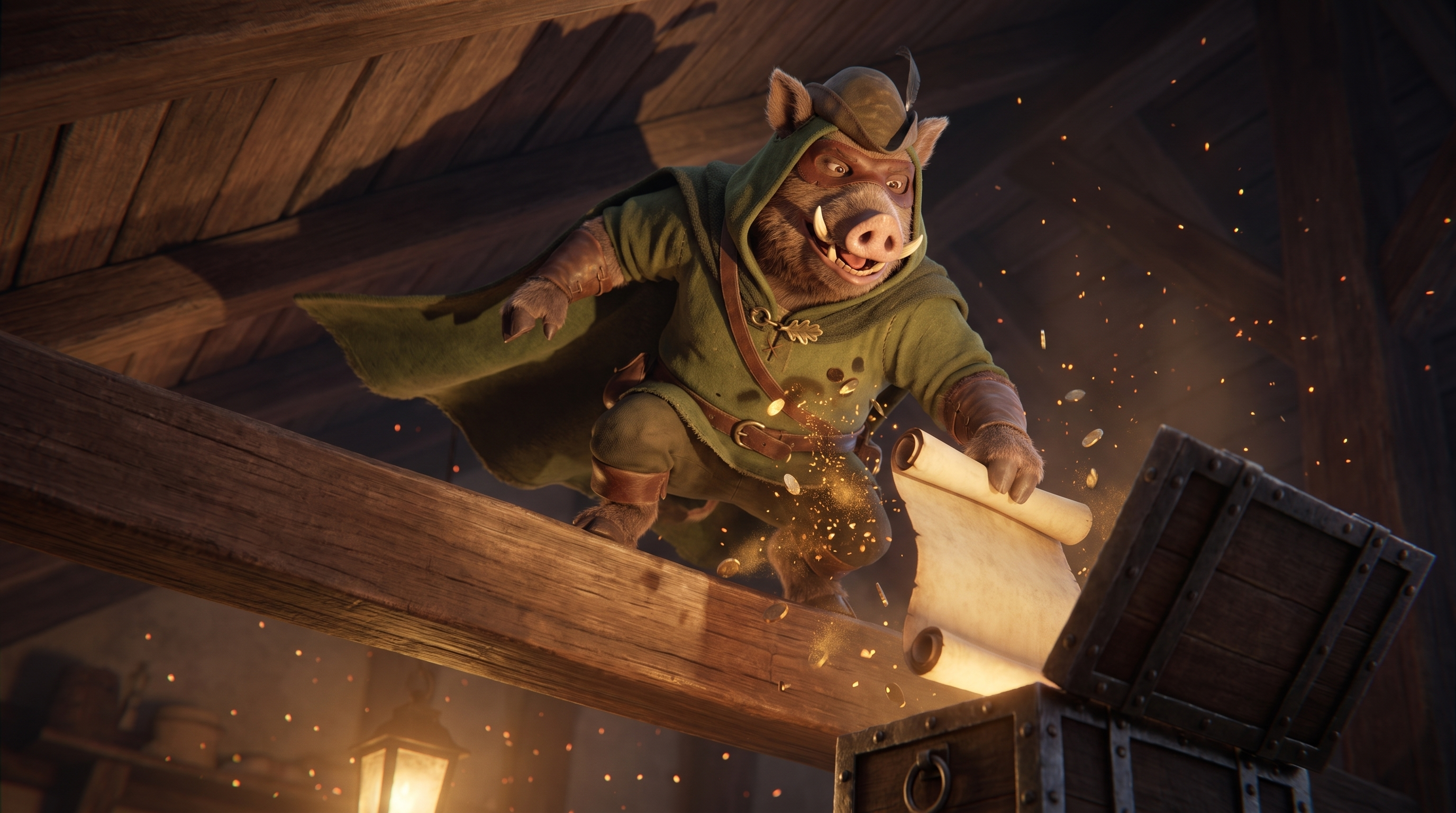
They already called him a pig. He kept the name.
On a trading floor, “pig” is not an animal — it’s a verdict. Bulls make money, bears make money, pigs get slaughtered. The pig is the one who holds a minute too long, who wants the last tick, who gets carried out. It is the exact insult professionals reserve for people who behave the way everyone behaves on this chain.
So Hogwood takes the insult as a name, puts a hood over it, and goes to work. But it can’t redistribute money — that would require actually stealing it, and it will not touch a single coin that isn’t its own. So it steals the one thing that can be taken freely and legally: the numbers.
Robinhood Chain was built so real-world assets could live on chain. Almost none did. Nobody publishes how few. Nobody explains that a Stock Token is a debt security with no rights attached. The sheriff’s ledger is public and unread — and an unread ledger is just a locked one with extra steps.
The folklore has to be
mechanically true.
A label that claims something the product doesn’t do is the cheapest lie in this industry, and the easiest one to catch. So every part of the story maps to something on this site that actually runs, and that you can check without trusting us.
Read the ledger
Every stock token’s supply and price, added up by us from the contracts. Saved daily so the history survives the rolling window.
Publish it free
No sign-up, no wallet, no gate. The numbers nobody else shows, shown to anybody who opens the page.
Show the failures too
Every call we make is logged, successful or not. If we break, you see it before we do.